Imagine: you’re in a car with your childhood best friend. He accidentally hits a child crossing the street. Your friend was clearly driving above the speed limit. The police question you as a witness. Will you tell the truth, even if it condemns your friend? Or will you lie to save him?
If you choose to tell the truth, congratulations: you answered like a true WEIRD person (Western, Educated, Industrialized, Rich, Democratic). This is the typical behavior of many Westerners, especially in the United States, Switzerland, the Netherlands… And this character trait, prioritizing impartial rules and universal truth over clan or friendship loyalty, is associated with richer and more prosperous societies. Let’s see why in this massive tome by Joseph Henrich.
I finally finished this massive work by Henrich. I had started it at the end of 2024, then dropped it. So I picked it up again at the end of 2025, after first reading his previous book which I discuss here (The Secret of Our Success). And two other books that deal with the same theme. As you can see, I’m really trying to dive deep into this subject that fascinates me and attempts to explain the current state of the world by going back to its origins.
Henrich’s Ambition
Henrich’s ambition is nothing less than to show how Europe gained an advantage over other civilizations starting from the 18th century and what the root causes are of this gap that widened between European civilization and the rest of the world. Indeed, as he himself recalls, a great scholar from the East, Ibn Khaldun, had noted that civilization was essentially the work of Jews, Greeks, Indians, Chinese, and Arabs. Blacks were, according to him, the barbarians of the south and Whites the barbarians of the north, incapable of developing any civilization because of the cold…
1000 years later, the “barbarians of the north” would make exactly the same remark about the savages of the south. This definitively proves that everyone, in the same situations, ends up producing the same acts and the same thoughts.
So how did the Europeans do it?
The Central Thesis: The Church Broke the Clans
Europeans developed better institutions that slowly formed as a result of their particular psychology. Where does this psychology come from? The Church! But not as you think. It’s not about morality or Christian values, at least not at first. The Church destroyed something in the West that is present everywhere else: clan and tribal ties between individuals.
By prohibiting marriages between cousins up to the 13th degree, the family unit was reduced to its simplest expression. This had a direct psychological effect first, then a social one. Europeans became more analytical, impersonal, anti-conformist, individualistic. And as tribes and clans gradually disappeared, other institutions had to be invented to cooperate: brotherhoods, guilds, joint-stock companies…
The Church, by breaking these tribal ties, gave Europeans the opportunity to increase the scale of their cooperation capacity, which in other civilizations remained limited to family ties.
Proof by Map
Information, techniques, and science circulated better between individuals. Many innovations appeared outside Europe: paper, numbers, zero, gunpowder, printing, navigation… But only the European ecosystem, with its common culture, its warring cities, and its scientists and intellectuals all communicating in a vast network, managed to give birth to modernity.
Modernity doesn’t depend on a few isolated geniuses: it requires a huge concentration of individuals with complementary skills and a certain freedom to act. In other civilizational areas, blood was always a privileged means of transmitting knowledge, which de facto limited the number of people to whom one could transmit. From generation to generation, there was not as much accumulation of knowledge as in the West.
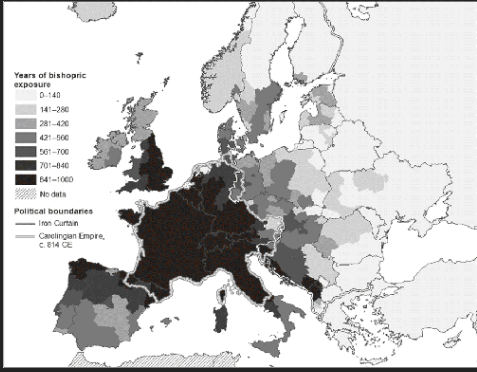
Henrich is very convincing, but he also backs up his claims with evidence when he can. The one that struck me most is the map of Europe during the Carolingian period where we see that the churches, which initiated this social upheaval, stop right in the middle of Italy. Cousin marriages are more frequent in southern Italy and… guess why southern Italy is famous for its mafia?
Globalization Continues the Process
And what’s crazy is that this process is not frozen in the past: it continues today with globalization. Look at Japan at the end of the Meiji era: to modernize at full speed and catch up with the West, they reformed their family system, abolished old feudal clans (the ie), imposed inheritance equality, and broke many traditional clan ties, a bit like what the Church had done in Europe, but in accelerated and conscious mode.
Same for India and China in the mid-20th century: these countries adopted “modern” laws that prohibited or strongly limited marriages between relatives (uncles-nieces, cousins, etc.) to promote more individualistic nuclear families and impersonal institutions. And in the rest of the world, especially in sub-Saharan Africa colonized by Europe, colonial powers forced the adoption of these European matrimonial norms, often by imposing civil code or discouraging traditional clan unions.
As a result, globalization is slowly accompanied by a globalization of Western (WEIRD) characteristics: individualism, impersonal trust, analytical thinking, etc., towards the rest of the world population. It’s not racial or moral superiority, it’s just that these psychological and institutional traits spread because they allow massive cooperation, innovation, and growth, and the whole world wants (or is forced to) play in this game now.
Conclusion
In short, this book is truly fascinating. I obviously didn’t cover or retain everything and it really deserves careful attention. Especially if we want to move beyond simplistic theories like “Whites are bad and domineering, that’s the reason for their success.”